Plurilingual
French acts as a bridge to Spanish. African languages known by the learner will be available as optional layers, with none made compulsory.
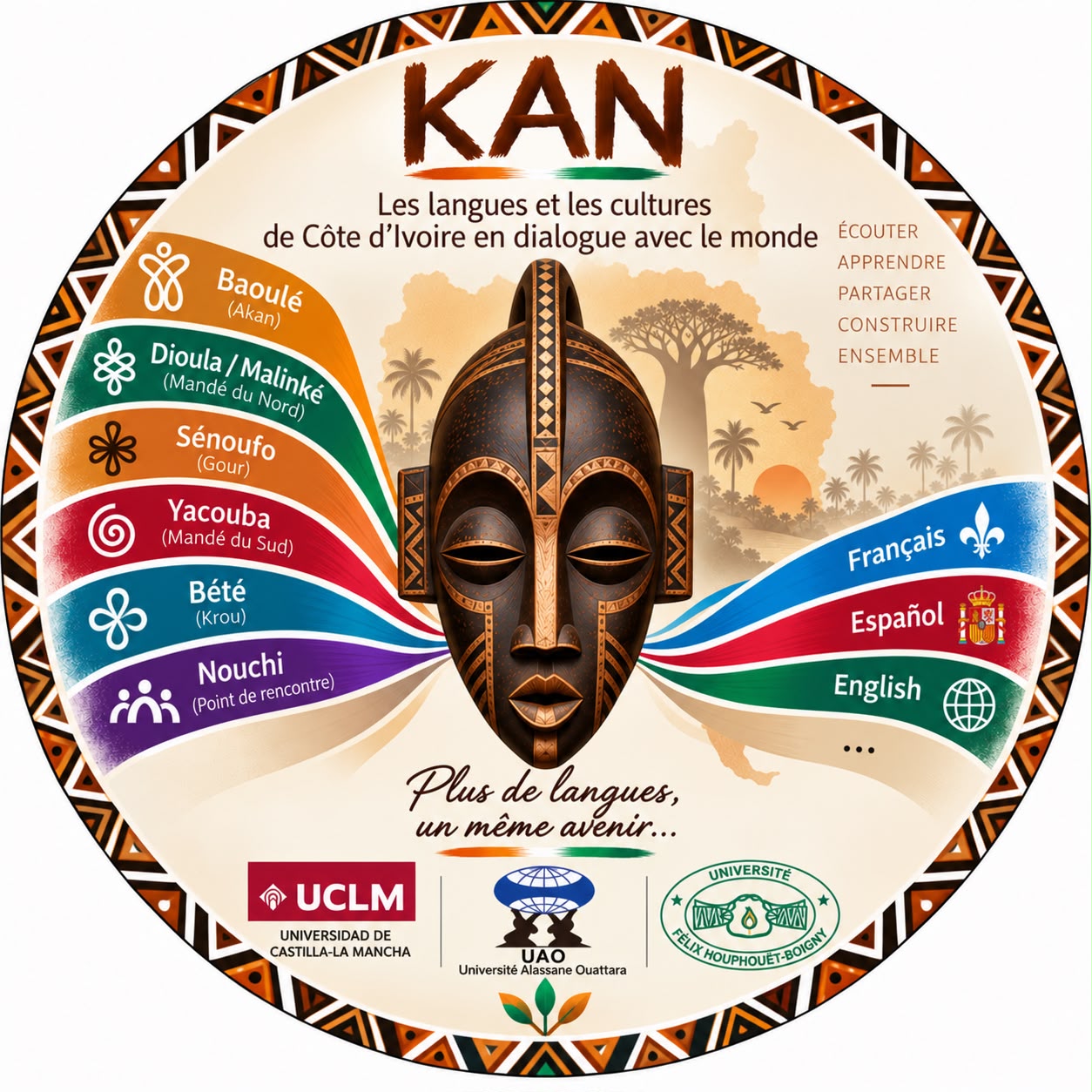 KAN
KAN


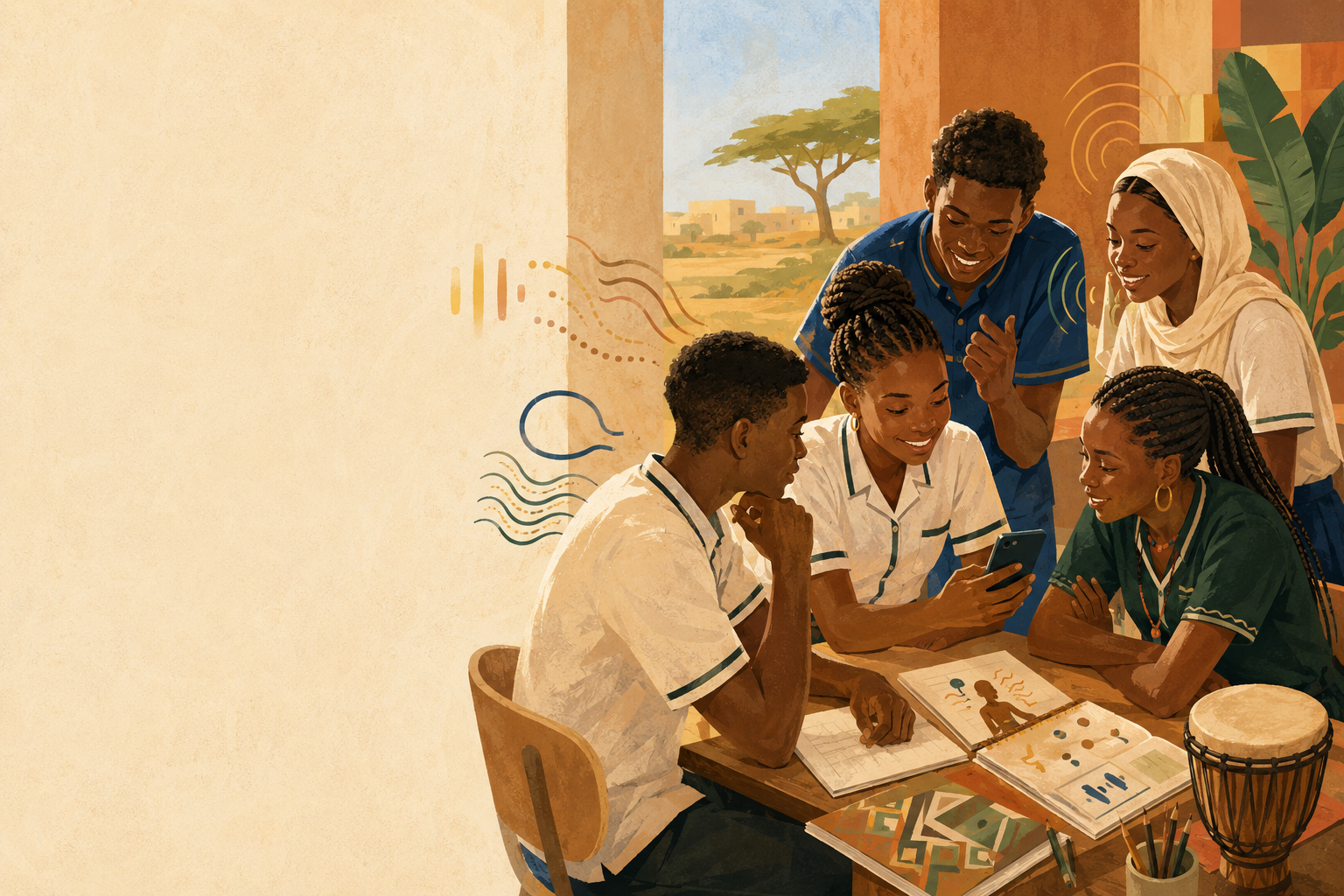
KAN is a family of cognitive, multimodal, integrative and plurilingual digital methods designed for foreign-language learning in African educational contexts.
Initial phaseSpanish · francophone secondary school · from 4e
Languages learners already know become resources for learning.
One simple principle
French acts as a bridge to Spanish. African languages known by the learner will be available as optional layers, with none made compulsory.
Voice, image, rhythm, gesture, reading and writing reinforce one another within the same learning experience.
KAN works alongside official curricula and textbooks. It complements them; it does not replace them.
Explicit contrasts, guided progression, recall and reuse help learners understand and develop automaticity.
Active progression
Each sequence connects perception, production, movement and meaning. Learners progress through short, cumulative steps, with support gradually reduced as autonomy grows.
Contrastive architecture
Known African languages and other languages already learned
Optional national-language layers — next stageLanguage of schooling and shared explanatory bridge
The first target language in the KAN family
One coherent system
KAN replaces neither the teacher nor official resources. It adds what a phone can offer to classroom learning: listening, repetition, interaction, personalised practice and immediate feedback.
The classroom remains the setting for mediation, pair or group interaction and shared tasks.
Official curricula and materials provide the framework; KAN complements them through a compatible progression.
Learners listen, pronounce, read, write, record themselves and listen back to their own voice, in or out of class.
What digital adds
Today
The first phase focuses on francophone secondary education, with Côte d’Ivoire as the initial reference context. The experience is designed mobile first, supporting classroom teaching and the textbook.
Teenagers beginning Spanish in francophone secondary education.
A reference setting for designing, adapting and trialling the first version.
Clear, touch-friendly, progressive and accessible activities for small screens.
Pilot status
The internal version brings together the essential graphemes and systems of the first pathway, with guided progression, targeted review and a final assessment. It remains reserved for validation and experimentation: public access is not yet open.
Progress is saved automatically on the device. Human voices and general secure synchronisation are still being prepared.
Grapheme–phoneme production initially follows the Peninsular Spanish norm. Varieties across the Spanish-speaking world, including seseo, are acknowledged in short discovery capsules.
Initial reference context
Situations, characters and school practices are grounded in recognisable Ivorian realities, with a contemporary, dignified and stereotype-free representation.
Inside the app
KAN Español is a mobile-first application that turns the first phonographic pathway into short, guided and cumulative activities. The internal pilot brings together 31 modules, five intermediate stages and one final stage: 37 structured activities.
The pathway, pseudonymous profile, automatic resumption, local voice recording, progress tracking and teacher area operate in the internal version. The application file is neither published nor offered for download on this site.
31 + 5 + 1
The sequence moves from the foundations to more complex spelling systems, then checks that learners can use them together.
Vowels · M · P · N · L · S
T · D · B · V · F
R · RR · C · QU · K
G · GU · GÜ · J · Z
Ñ · Y · LL · H · X · CH
Review and assessment across all systems
KAN Español
Modules go well beyond listening to a word: they connect perception, memory, gesture, voice, writing and communication.
Observe the spelling, listen to a Spanish model, select the sound heard and discriminate between close contrasts.
Use French as a bridge language, identify similarities and differences, then discover Spanish rules and varieties.
Combine syllables and words, read aloud, observe cursive and print letter formation, then move into writing and mini-dictation.
Repeat a model, record a voice on the device, listen back and try again without sending the audio to a server by default.
Consolidate sound systems through prosody, short songs, call-and-response, gesture and collective movement.
Work in pairs or groups, explain a point with a support language when needed, and finish with an acquired / developing / reinforce profile.
A name-free KAN code, a button to continue from the last point, percentage progress and an option to reset local data only.
The internal version can display the current session or local history, show a detailed pathway summary and export events as JSON for authorised analysis.
Participation in improving KAN is voluntary. No name, email address, phone number or postal address is requested; real server synchronisation is not yet active.
37 activities, automatic resumption, local progress, an on-device voice, recording and playback, a low-data guide and an internal teacher area.
Usability across phones, device-dependent voice quality, pedagogical consistency, data-protocol security and supervised field testing.
Human voices, secure synchronisation, release of the validated application and progressive development of national-language support layers.
App and resources
The internal KAN pilot already includes local progress tracking, a low-data guide, an audio explanation and a practical PDF. They will be published with the validated version of the app.
The pilot loads its content once through the available network — operator mobile data or Wi-Fi — and keeps the activities and progress on the device to avoid continuous downloads.
Use operator mobile data or available Wi-Fi; Wi-Fi is not required.
Loaded activities and local progress remain available on the device if the connection drops.
An occasional connection will support updates and, once enabled, the secure synchronisation planned for the research setup.
Practice voice recordings remain on the device and are not sent to the server by default. Scientific improvement relies on optional consent.
A complete mobile pathway with 31 modules, 5 intermediate stages, a final stage and automatic progress resumption.
Public access after validationPractical guidance on the initial load, using mobile data and continuing activities offline.
Publication with the validated versionAn available Spanish voice on the device guides listening; learners can record and listen back to their voice locally. Human voices are planned.
Human recordings in preparationA growing family
First implementation: a complete phonographic pathway for beginning Spanish as a foreign language from 4e.
Planned adaptation for English as a foreign language, from 6e in the Ivorian reference framework.
Each new branch will mobilise African languages, school French and languages already learned.
Deux champs, une vision éducative
Foreign-language learning in African educational contexts.
Literacy and learning to read and write in French as the language of schooling.
Responsible research
KAN is designed to support rigorous scientific observation while keeping research data strictly separate from personal data.
Each learner uses a unique code. The pilot does not request a name, email address, phone number or postal address.
Progress and practice voice recordings stay on the device; voice is not sent to the server by default.
Using learning data to improve KAN is optional. Scientific data remain separate from any real-identity table.
Scientific and institutional setting
KAN brings together research, educational innovation and knowledge transfer within the University of Castilla-La Mancha, the Faculty of Education in Albacete and its Edulab, as well as the LIMITE research group.
The university framework for the project’s design and development.
The setting for educational design, coordination, innovation and the development of digital educational resources.
Scientific and knowledge-transfer setting. Alfredo Segura Tornero is co-principal investigator of the group.
University collaboration in Côte d’Ivoire
KAN will be developed in collaboration with Université Alassane Ouattara in Bouaké and Université Félix Houphouët-Boigny in Abidjan. Their participation strengthens the project’s university foundations and its adaptation to the Ivorian educational context.
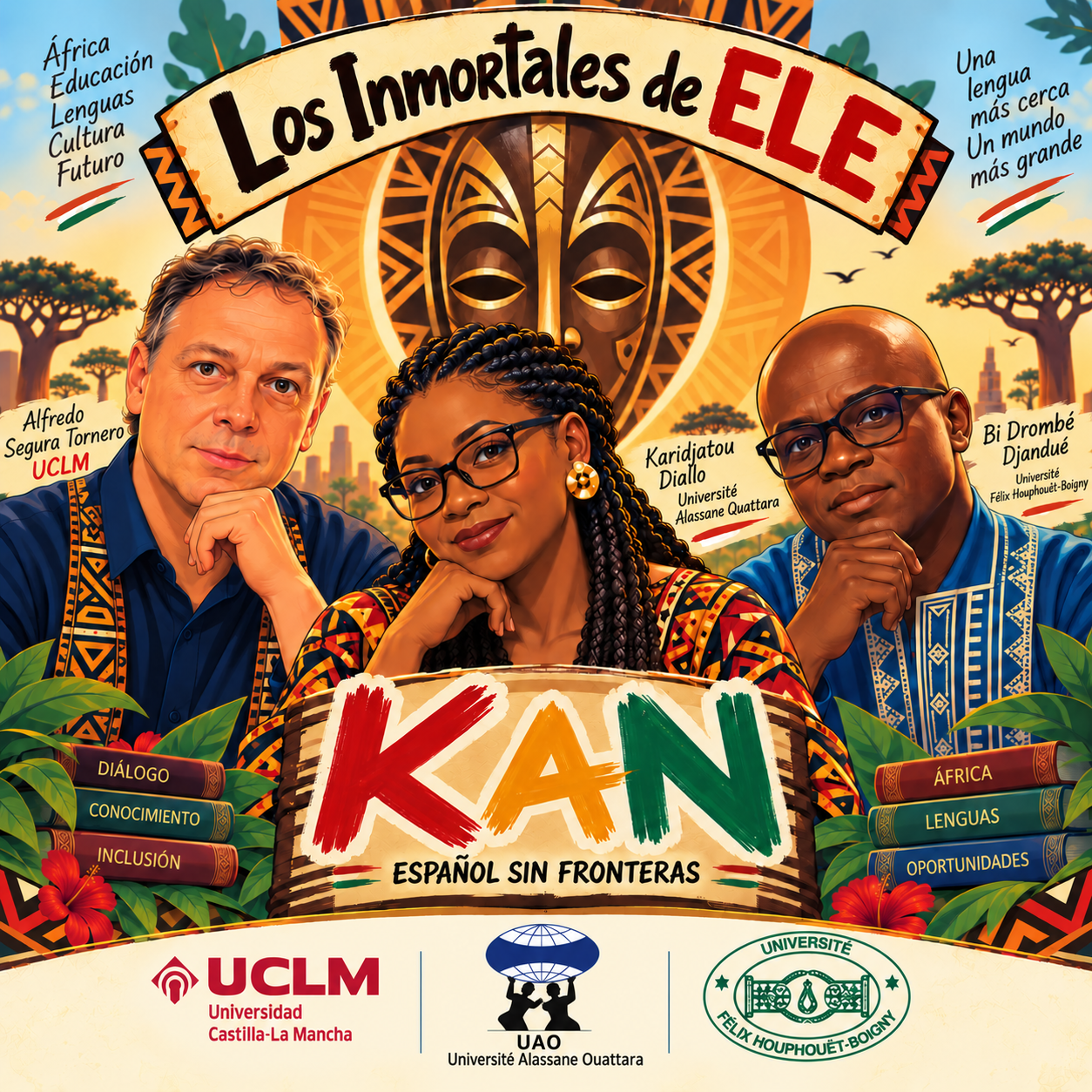
Ivorian partner university contributing to the scientific and educational work of the KAN project.
Lecturer and researcherKaridjatou Diallo
Ivorian partner university contributing to the scientific and educational work of the KAN project.
Lecturer and researcherBi Drombé Djandué
Developed through the UCLM SAFICEP projects
Co-principal investigator of the LIMITE Research Group (UCLM) · Faculty of Education, Albacete
Design and authors
KAN is designed and developed within a university framework for research and educational innovation.
Each resource includes its authorship, version, date and protection notices. Any reproduction, modification, redistribution or commercial use requires written permission.